Click here to return to the world ecofiction series
About the Book
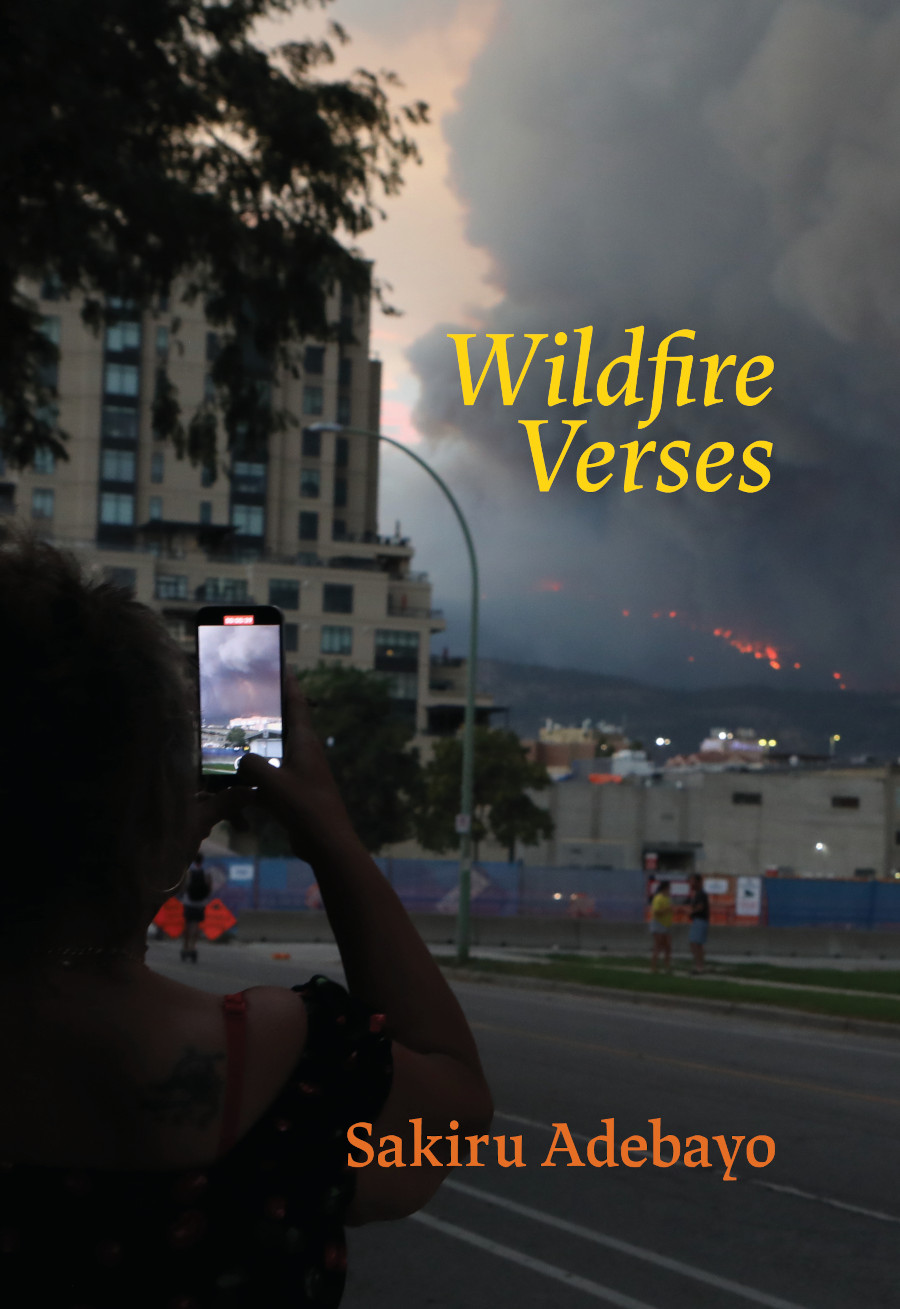
Written in the aftermath of the 2023 McDougall Creek wildfire, Wildfire Verses chronicles the experience of displacement and the emotional toll of living through a climate disaster. Drawing on his evacuation from Kelowna during the fire, Sakiru Adebayo explores what it means to become a climate refugee while reflecting on the unequal impacts of a warming world. Urgent yet ultimately hopeful, these poems call for collective action, resilience, and a renewed sense of responsibility toward one another and the planet. You can also find the book at Canadian Indie Bookstores. The publication date is September 22, 2026.
Author Interview
Dragonfly has permission to reprint most of the interview from the press kit, but I’ve also asked a few questions at the end of this interview.
Your debut poetry collection, Wildfire Verses, was inspired by your experience during the 2023 Kelowna wildfire evacuation. How did living through that event shape the poems in the collection?
Being in the heat (no pun intended) of the McDougall Creek fire was a very deeply terrifying experience. I had not experienced anything of that scale before. From my apartment in Glenmore, I could literally see the fire on the mountain as it raged and spread from one location to another. The area where I lived in Glenmore was declared a danger zone, so I had to flee to a friend’s house in Vernon, where I stayed for over a week until Glenmore was declared safe again. It all happened so quickly. And, as one of the titles of the poems in the collection attests, the constant feeling of displacement for that one week made me feel like a climate refugee. This, of course, is not to diminish or trivialize the tragedy endured by real refugees (of war and the climate crisis); yet during that one week (and a few days) I lived in Vernon, I had none of my possessions with me. I was evacuated from my place so quickly that I didn’t have time to pack my bags or bring my work laptop. My friend had to lend me some clothes, and they (the family) also had to feed me throughout my stay with them. It was a harrowing experience that, again, words fail me to describe. I had nightmares from that experience. It was this feeling of displacement and frustration, even if transient, that I wanted to capture in Wildfire Verses. It is also worth mentioning that I didn’t set out to write a poetry collection. In fact, I had never considered myself a serious poet, even though I wrote poetry now and then. However, while stranded and traumatized in Vernon, I turned to poetry for some catharsis. It started with one poem, but by the end of my one-week stay, I had written over forty poems. The poems in this collection are a witness to how it feels to be caught up in the fire. They serve to remind us of the breadth of the tragedy of the McDougall Creek fire and of the urgent need to act on climate change before it is too late.
Some of the poems in the collection explore identity, especially your identity as a Black African-Canadian living in the Syilx Okanagan territory during a climate disaster. Can you elaborate on this particular angle in the collection?
Oh yes…. This is an important thread in the collection. It was something I had at the back of my mind throughout the entire process. I remember seeing a sense of we-are-in-this-together all over social media in that year. This collective expression of vulnerability and solidarity was very encouraging to see. And this is why I sometimes choose to write in a first-person plural voice in the collection. The poem, “I speak of a We,” helps contextualize and rationalize this choice. That said, by the time the wildfire happened in 2023, I had lived in Kelowna for three years and had tried my best to learn about Indigenous lives and cultures in the Okanagan Valley. I had learned a bit about the Valley’s colonial and racial politics, so I was aware that even though the wildfire was no respecter of persons, its consequences were not evenly distributed. I knew that some communities were more affected than others. I also knew that the government didn’t actively listen to Indigenous solutions to the fire crisis, which is interesting because one would think that the Indigenous community is the one the government would first run to. I knew that the Okanagan was no stranger to wildfires and that Indigenous people had ways of dealing with them, even before the arrival of the settlers. We kept running in circles because we hadn’t yet centered the knowledge of the custodians of the land in the way we grappled with the wildfires. Additionally, I knew that the Okanagan is predominantly white, with only a small Black, mostly Caribbean, population. So the collection explores the colonial and racial politics of climate change, and specifically helps me explore my place in these conversations. It is also about how I situate (but do not centre) myself and my grief, particularly in a critical moment of climate catastrophe in this region. Overall, the collection is an attempt to find the parts that connect me (a Nigerian Canadian) to the Okanagan story.
Your poems encourage readers to think about how climate disasters affect both people and the natural world. Why was that important for you to explore in this collection?
Writing Wildfire Verses allowed me to think expansively about ecological disasters of all kinds because I realized they are more connected than we might think. I also discovered that our anthropocentrism is partly responsible for why we think about these climate catastrophes in silos. So, in writing the collection, I tried my best to move beyond the human perspective (there is a section titled “Posthumanism”). Once I did that, a whole new world became accessible to me. Humans are not always the most affected by climate catastrophes, even though they are often the major cause of it. In the event of a wildfire, for example, the animals that live in the wild experience displacement, hunger, and death too. The land bears a lot of pain during a wildfire, and it takes a while for it to recover. The trees burn, the lakes boil, and the air is contaminated during a wildfire as well. In my opinion, the conversations during the McDougall Creek Fire were very human-centric. I think a balanced and productive conversation about climate disasters must take into account not just humans but also the natural world. If we really want to tackle climate change, we must start thinking planetarily about everything.
Although the book addresses fear, loss, and what it means to feel like a climate refugee during a state of emergency, it also speaks to community and collective action. What do you hope readers will take away from the collection?
If you look at most climate activism groups (Friends of the Earth, Youth Climate Movement, People’s Climate Marches, Earth Strikers, etc.), you will notice that they all acknowledge and also emphasize the need for collective action. This is because they have realized that climate change is the best teacher on the futility of border thinking. Take a look at Hurricane Hilary in Southern California, which sent moisture all over British Columbia or the wildfires in Quebec, which blanketed Ontario with smoke. These examples remind us that creation care is not a one-man or one-country job. All hands have to be on deck to deal with climate change. Humans must learn the virtues of earthly co-existence with other humans and non-human beings. The government must work cooperatively with experts, activists, international organizations, and local stakeholders in this important work called creation care. So, I hope readers come out of the collection with a renewed sense of responsibility for the world we live in. I hope people no longer think that a climate crisis in Pakistan or the Philippines does not affect them because climate, again, defies methodological nationalism. We should all speak up against climate injustice and negligence, whether that be in our community or in other communities. Lastly, my collection does not leave readers in despair. It shows that there is hope, especially in collective efforts.
The collection comes from a deeply personal place. Can you describe whether writing the collection has changed you as a person?
There is a poem in the collection titled “Kelowna Taught me about Consuming Fires.” It encapsulates how Wildfire Verses changed me as a person. This might sound sentimental—or even cheesy—but the truth is that this collection changed me; it changed the way I see the world. In writing the lines of each poem, I came face-to-face with the reality of climate change. In scribbling each verse in this collection, I became a witness (to the wildfires). I am more environmentally conscious now. Coming from the interior of Southwestern Nigeria (where we have our regular share of socio-political and economic crises), ecological issues were never a thing of grave concern. I left home a long time ago, so things may have worsened now, but growing up, the worst climate issues I experienced were small-scale floodings that dried up in a matter of days. But ever since moving to Canada, words like “tornado,” “snowstorm,” “hurricane,” and “wildfire” have become part of my daily vocabulary. I have learnt that North America is not a climate haven. In becoming aware of the urgency and close-up effect of climate change, I have also become more ecologically responsible in the way I live my life. On another note, this collection has opened me up to another aspect of myself (my creative/poetic self), which I hope to tap into further. In other words, this collection, despite its difficult subject, is a gift to me. It is a gift of self-discovery. Instead of spiralling in despair, I can always take up a pen.
What are your poetic influences, and how do you invoke them in this collection?
This is a very good question. My influences are many––but I do not think that I consciously invoke them in my writing. In fact, I only discovered these hidden influences in the process of re-reading the collection. My BA and MA degrees are in literatures in English, which means I have been exposed to literature from all kinds of places. For example, there is a poem in the collection that follows the structure of an Old English poem titled “Deor’s Lament.” The interesting thing about “Deor’s Lament” is that I came across it in my first year English poetry class about twenty years ago. But it came back to me while I was writing this collection and provided me with the structure I needed to write a particular poem. There is also a reference to Dante’s “Inferno” everywhere in the collection, including a reference to Steinbeck in the poem titled “The Grapes of Ecological Wrath.” There are also African writers and poets (Niyi Osundare, Warsan Shire, Dinaw Mengestu, Kofi Awooner, Veronique Tadjo) whom I draw on directly and indirectly in the collection. I draw images and metaphors of fire from the Bible as well. I remember taking a course, as an undergrad, on the “Bible as Literature.” That course helped me to see the Bible as a brilliant literary text which actually has a lot to say about wildfires. I borrow titles from writers like Celestine Ng (Little Fires Everywhere) and James Baldwin (The Fire Next Time) as well. I am also influenced heavily by music. There are obvious references to Aśa and the Grateful Dead (“Fire on the Mountain”) and oblique references to Coldplay, Imagine Dragons, Nasrin Kadri, Anoushka Shankar, Pharrell Williams, Lana Del Rey, and many others in the collection. Lastly, titles and ideas from academic books on ecocriticism also made it into the collection.
Additional Q&A from Dragonfly
Mary: Would you be comfortable sharing your upbringing and your early writing? I’d be curious to hear how those experiences shaped you as a writer.
I grew up in a large family. People were always around. I was never alone; yet I always had this inexplicable and prevailing sense of melancholy which I eventually channelled into writing. But I also suspect that my grandmother had something to do with my journey as a writer. She used to tell us moonlight stories, which really expanded my imagination as a child. So I’ll say that a combination of grandma’s moonlight tales and my own melancholic temperament as a child shaped me as a writer. I didn’t keep any of my early writing (I am just learning the art of archiving as a creative writer), but I am happy to share the poem below. It was the first poem I wrote when I moved to Canada.
HOPE MOUNTAIN
Written on a road trip on the way between Princeton, Hope, and Coquihalla in British Columbia
This ginormous beauty
with perfectly braided green hair
towers over us,
with an optimistic presence;
She crowds us with stamina,
but also seduces us
with her precious stones,
and extols us with her
picturesque little streams of life
as well as the sweet savour
of her scratchy waterfalls
Mary: Thank you for that! What is one of your favourite experiences in nature, and how did it feed your creativity?
I love hiking in the forests or walking by a large body of water (lakes or beaches). I love the sound of a flowing river and of birds chirping in the woods. My experiences in these spaces fill me with awe and remind me that I am just a very tiny piece in this huge equation called the universe. And, of course, nature activates my senses (of sight, smell, and hearing) and gives my mind a kind of crystal clarity that’s needed to create. There are times when creativity comes from life’s cacophony, confusion, and high-octane emotions, but I don’t think that I can fully function creatively without walking regularly by the lake or in the forest.
Mary: What conversations do you hope Wildfire Verses will spark among readers, especially now, given that so many around the world are navigating violent conflict, displacement, and environmental challenges?
Wildfire Verses was born as a personal, traumatic response to the McDougall Fire in 2023, but it was also written as a cautionary tale for a world warming so quickly and drastically. Between 2023 and 2026, we have witnessed even more extreme wildfires all across Canada. We have seen more ecological disasters around the world over the past three years. The accelerating frequency of these disasters means there will be no respite for us soon. This is our new normal. It is sad, but it is a reality we all need to embrace. So, my hope is that this collection will inspire reflections in readers. The poems helped me navigate a tragic season of climate catastrophe, so I hope they can do the same for readers going through one climate catastrophe or another. More importantly, I hope the collection will make readers more environmentally conscious. I hope it will inspire people to care more about the environment.
About the Author

Sakiru Adebayo is an assistant professor and the James and Eva Good Chair in English Literature at Western University. Before moving to Western, Adebayo worked as an assistant professor in the English department at the University of British Columbia Okanagan from 2021 to 2025. He is the author of Continuous Pasts: Frictions of Memory in Postcolonial Africa (University of Michigan Press). He is the winner of the Nigerian Prize for Literary Criticism (2022) as well as the Amílcar Cabral Prize 2023. He lives in London, ON.