I’m so happy to provide a new Turning the Tide spotlight, which focuses on literary art for younger audiences, whether that’s for young children, middle-grade, teens, or YA. Today’s spotlight is on Jessica Jane Robinson, an award-winning environmental educator, author, filmmaker, and superhero Resilience. She is the Founder and CEO of Resilience Birthright, where she combines storytelling, science, and fantasy to inspire people of all ages to recognize their power to make personal sustainable actions that can help heal the planet. For over 15 years, Jessica has developed and implemented environmental education and zero-waste programs, helping schools, businesses, and communities adopt more sustainable practices. Her firsthand experiences working with children and communities inspire the stories she creates, connecting real-world environmental challenges with imaginative adventures that encourage curiosity, compassion, and action.
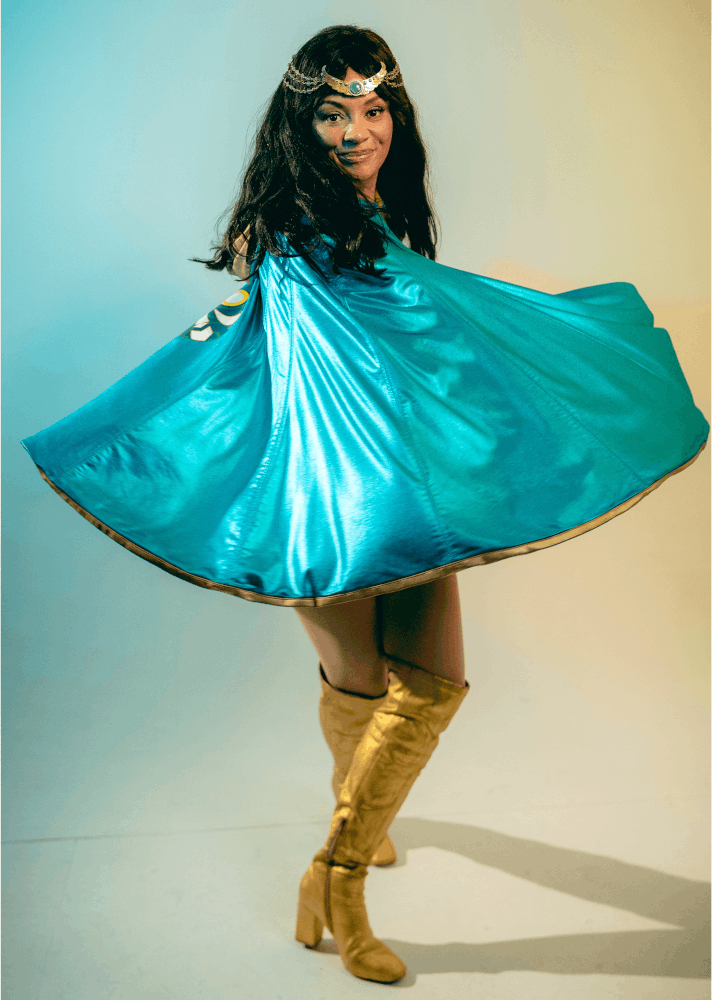
She is the author of Resilience Birthright: Origins of Resilience, Resilience & Friends: Cycles of Nature, and her latest novel, Ecosystems Matter. Her books and accompanying standards-aligned educational resources introduce young readers to the wonders of nature, the interconnectedness of ecosystems, and humanity’s responsibility to protect the planet. Through her books, films, music, and educational programs, Jessica continues to build a universe where environmental science meets superhero storytelling, reminding audiences that we all have extraordinary powers within us to help create a healthier, more sustainable world.
Dragonfly readers can get 15% off items in Jessica’s website shop with the code Dragonfly15. You can find more about Jessica on her social media.
Mary: What’s your super power?
Jessica: My superpower is my ability to inspire and mobilize people to take simple actions that collectively make a difference for our planet. I discovered my superhero powers over 15 years ago, when I was representing the City of Alameda (my hometown) in the Miss California USA pageant. I wanted to make a difference and be more than just a voice on a stage, wearing a crown and sash. I wanted to use my platform to help make a difference in Alameda and, most importantly, “walk my talk.”
That’s what inspired the grassroots program called Miss Alameda Says Compost. I had the opportunity to work alongside the City of Alameda and its local waste and recycling hauler, ACI. I went door to door, asking restaurant owners to compost and recycle voluntarily before the city adopted the program and made it law.
I wasn’t asking restaurant owners to do something convenient. I was asking them to change how their businesses operated, train their employees, adopt new habits, and handle unexpected issues that might arise from the changes. My program provided color-coded containers to make sorting easier, and participating restaurants could potentially reduce their garbage bills by diverting recyclable and compostable materials and receive a framed MASC certificate with their waste-diversion stats and my signature.
However, I discovered that one of my most effective tools for convincing business owners was leading by example, and getting my hands dirty. When I visited restaurants to demonstrate the program, I strategically positioned the containers, rolled up my sleeves, put on gloves, and started digging through their mixed bags of garbage. I sorted through all the materials myself in every back-of-house bin, showing owners and employees what could actually be composted or recycled and what truly belonged in the trash (which was very little).
I believe successful leadership requires integrity and leading by example; you cannot ask someone to make a change you aren’t willing to make yourself. I would show up and get my hands dirty to demonstrate that I believed in what I was asking them to do. In response to my approach, the restaurants would comply in return and show me so much love and gratitude. I brought more than 150 of Alameda’s approximately 300 restaurants into the program before composting became a legal requirement, one restaurant at a time for over 4 years.
I even expanded my work into schools, helping students and educators adopt recycling and composting practices and supporting AUSD Go Green. That’s when I began to recognize something special about my ability to connect with people of all ages. I discovered that the same passion that motivated restaurant owners to change their business practices could inspire hundreds of children to join their school Green Teams and take daily actions that support their schools’ sustainability goals.
What started as a grassroots campaign became the foundation of my journey as an environmental superhero. I learned you don’t need extraordinary powers to make a difference; you need a good heart, clear intentions, and the willingness to lead by example. I learned my greatest superpower is helping others recognize the power they already have to heal our world.
Mary: What amazing outcomes! I love getting my hands dirty too; that’s a great down-to-Earth feat. What do you do for a living, and does that contribute to your writing?
Jessica: I am a writer, producer, director, educator, and a real superhero. For over 15 years, I’ve created environmental documentaries, written graphic novels and environmental literacy books, worked in schools, and helped communities implement zero-waste and sustainability programs.
Everything I write is connected to my work, my passions, and my experiences.
Through my work, I’ve developed a deep understanding of what it takes to inspire cultural and social change, particularly around sustainability. I’ve learned that most people aren’t necessarily unwilling to make changes. Sometimes they lack awareness, access to information, or the opportunity to experience something outside of their everyday routines.
I’ve witnessed firsthand how education, encouragement, and a little creativity can transform the way people think about their relationship with the environment. Those experiences are what fuel my writing. Whether I’m developing characters for my graphic novels, writing environmental literacy books for children, or producing documentaries and short films, I’m constantly finding ways to translate what I’ve learned in the real world into stories that inform, entertain, and inspire.
I also learn from the people and children I work with. In fact, the inspiration for Resilience & Friends: Cycles of Nature, my environmental literacy book for K-2 students, came from a little boy who didn’t know where apples came from. I was visiting a kindergarten classroom to teach a waste-sorting lesson. I held up a toy apple and asked the children, “Where do apples come from?” A little boy raised his hand and confidently answered, “The store.” That wasn’t the last time I heard an answer like that, and it made me realize something important. We cannot take for granted that children understand where their food comes from or how the natural world works. We cannot assume they’re learning these things at home or even in school.
That little boy inspired me to write a story featuring Baby Resilience and Terry the Apple Tree, beginning with a simple question: “How do apples grow?” What began as a story about the plant life cycle grew into an interconnected collection of environmental adventures exploring pollinators and pollination, composting and earthworms, squirrels and forest regeneration, conservation, waste reduction, and recycling. That became the foundation of my first environmental literacy book, Resilience & Friends: Cycles of Nature. It later inspired my novel, Ecosystems Matter, which expands on those ecological concepts and explores more complex relationships within ecosystems for readers in grades 3–8.
I believe storytelling is one of the most powerful tools we have to connect people with issues that affect us all. Through my writing, I want people to discover something new, see the world from a different perspective, and recognize their power to make a positive difference. In many ways, my community work and my creative work are inseparable. One lets me experience and understand the world, while the other lets me share those experiences with others.
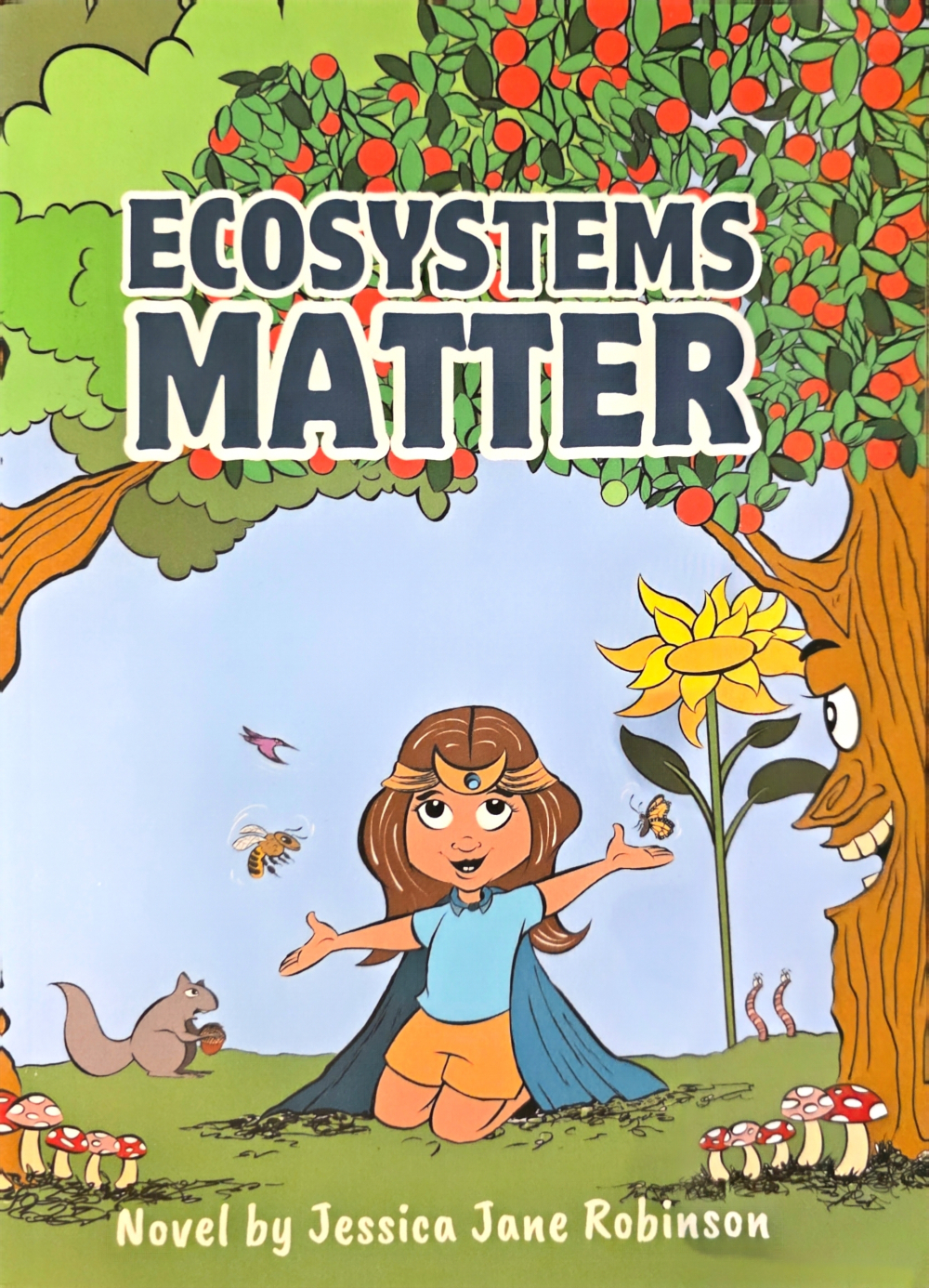
Mary: Tell us about your new book and more about what inspired it, or was it accidental?
Jessica: The inspiration behind Ecosystems Matter came from the response I received to my earlier book, Resilience & Friends: Cycles of Nature, and the educational resources I developed to accompany it. When I attend Comic Cons or visit schools, I often share my graphic novels and children’s books with teachers, families, and readers. People are always excited about the stories and characters. Still, I noticed particular interest when they learned that Cycles of Nature came with lesson plans aligned with the Next Generation Science Standards and Common Core State Standards.
People’s interest in Cycles of Nature inspired me to expand my environmental literacy resources beyond K-2. I saw an opportunity to create something for students in grades 3–5 that would build on what younger children were learning.
I also saw an opportunity to expand the world of Resilience. Another source of inspiration came from an unpublished chapter of my Resilience Birthright graphic novel series, which I originally wrote in 2014. In that chapter, Resilience remembers her childhood where she and friends get recognized for helping their school and school district Go Green. I wanted to go back in time and expand on that memory, exploring the childhood experiences that shaped Resilience into the environmental superhero she would eventually become. That became part of the foundation for Ecosystems Matter, allowing me to connect my environmental literacy curriculum with the larger fictional universe I’ve been developing for years.
I wanted to explore the years between those stories and give readers a deeper understanding of Resilience’s childhood, her developing abilities, and her growing awareness of the natural world. I began researching the science standards for grades 3–5 and looking for ways to integrate those concepts into the storyline. I built the novel around a core memory from my graphic novel series, expanding that experience into a much more detailed adventure that connects Resilience’s fictional world with real environmental science.
As the story developed, I found myself exploring ecosystems, living and nonliving components of nature, biomass, and the movement of matter and energy through food webs. I also wanted readers to understand how these natural systems connect to human activities, including resource extraction, land management, consumption, and the environmental damages caused by unsustainable practices. My goal was to make these scientific concepts part of the adventure rather than simply information students needed to memorize.
As I continued writing, I developed vocabulary and definition cards to help students understand the scientific terminology and key concepts introduced throughout the story. Then something unexpected happened. While discussing the book with a teacher I work with, I mentioned that I was incorporating plastic pollution and biomagnification into the storyline. She pointed out that some of these concepts were more advanced than what students typically study in grades 3–5 and would be more appropriate for middle school. That conversation changed the direction of my project. Rather than limiting the book to grades 3–5, I expanded the educational resources to include grades 6–8, creating different lesson plans that let students explore the same story at different levels of scientific understanding.
For my middle school readers, I wanted to go beyond traditional classroom activities and introduce opportunities for citizen science. Students can investigate their school’s waste culture, observe behaviors, collect information and track data from audits, and identify ways to encourage more sustainable habits among their peers.
In many ways, they’re being invited to become environmental leaders, just like the characters in the book. What began as an effort to expand my elementary environmental literacy curriculum evolved into a much larger project that connects science, storytelling, and real-world environmental action.
Ecosystems Matter wasn’t necessarily accidental, but it certainly evolved beyond what I originally imagined. The evolution of my projects is one of the things I love about the creative process and being open for expansion. Sometimes writing a story takes you on a journey, especially when you’re willing to learn from the people around you and be open to inspiration coming from unexpected events and places.
Mary: Can you tell us more about how your book aligns with nature and place?
Jessica: Ecosystems Matter explores nature and humanity’s relationship with the natural world, for better or worse. It explores how our actions affect the ecosystems we depend on, while showing readers that they have the power to make a positive difference. The fictional world I’ve created reflects our own. The story takes readers through real and imagined places, primarily throughout California’s San Francisco Bay Area. From Grandma’s Secret Garden, a backyard filled with discoveries about nature, to a school, the Martin Luther King Jr. Regional Shoreline, and the Monterey Bay Aquarium, each location provides opportunities to explore the relationships between living things and their environments.
The story also connects readers to the larger world, referencing places like Lake Tahoe, the Pacific Ocean, India, and other regions of our planet. These settings help illustrate that ecosystems are interconnected and that our actions, whether positive or negative, can have consequences beyond our immediate surroundings. I want readers to recognize that nature isn’t something separate from us. It’s all around us, from the trees in our neighborhoods and the wildlife in our parks to the watersheds, oceans, and ecosystems that provide the food, water, and resources we depend upon. We are part of nature, and our choices influence the health of the places we call home.
Most importantly, Resilience is a reflection of the readers. We are all resilient, and we all can create positive change. I hope that readers see a little of themselves in Resilience and her journey and recognize that they, too, have the power to be part of the solution and help heal our planet.
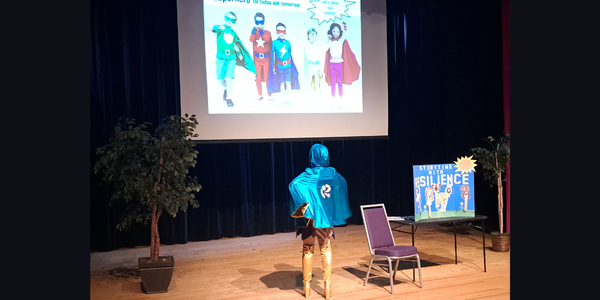
Mary: What dreams do you have about your future?
Jessica: One of my biggest dreams is to see the environmental education programs and methods I’ve developed over the past 15 years become a model that school districts can adopt throughout California and across the United States. I believe that expanding effective recycling, composting, and zero-waste programs is one of the most practical ways we can move toward a more sustainable future. Schools, businesses, and communities can take on sustainable local actions today helping make global impact.
I also dream of seeing my books and environmental literacy curriculum adopted by teachers, homeschooling families, and school districts nationwide. I created these resources to make environmental science more engaging and accessible, while helping children understand how their actions connect to the world around them. I want students to do more than learn about environmental challenges. I want them to feel connected to nature, confident in their abilities, and empowered to help shape the future they’re inheriting.
Beyond education, I hope to continue expanding the Resilience Birthright universe through graphic novels, animated stories, documentaries, and films that inspire people of all ages to recognize their own power to create positive change.
On a personal level, I dream of having the time, resources, and team to focus more of my energy on what I love most: creating, storytelling, exploring, and learning. I want to travel the world, learn from different cultures, meet people from all walks of life, and discover new perspectives and innovative approaches to sustainability. I want to learn firsthand from communities around the world and bring those experiences and lessons into my books, films, and educational programs.
I also dream of building a strong team that shares my vision and can manage the day-to-day operations of Resilience Birthright, so I can spend more time developing creative projects and collaborating with others. I want to continue growing as an artist, an educator, and a person, while creating opportunities to make a meaningful difference in the world.
Mary: What’s next for you?
Jessica: I’m excited about the upcoming release of Resilience Birthright: Origins of Resilience, a 30-minute web episode that combines live-action performances with animation to bring my environmental superhero universe to life. The production also features original music, including my songs “Earth Warrior” and “Love Letters to the Planet”, along with music from my lead actress, Arula, who portrays Queen Filoli, Resilience’s mother and the Queen of the planet Terravitae. I’m also looking forward to releasing chapters 2 and 3 of my Resilience Birthright graphic novel series, hopefully next year, with plans to adapt those stories into future web episodes.
Another project I’m developing is Storytime with Resilience, a series inspired by my environmental literacy books, Resilience & Friends: Cycles of Nature and Ecosystems Matter. My vision is to bring these stories to life in ways that entertain, educate, and inspire children to discover their connection to nature.
Ultimately, I want to continue expanding the Resilience Birthright universe through books, music, animation, and film, creating stories that inspire people of all ages to recognize their own superpowers and make a positive difference in the world.
Mary: Thanks so much for all the positive work you do for this world, kids, and building a better future.