Author Kimberly Christensen has reviewed a lot of children’s and YA eco-books for this site, and she now has her own book out: The Brink Box, so I decided to feature her in Dragonfly.eco’s Turning the Tide (for younger readers).
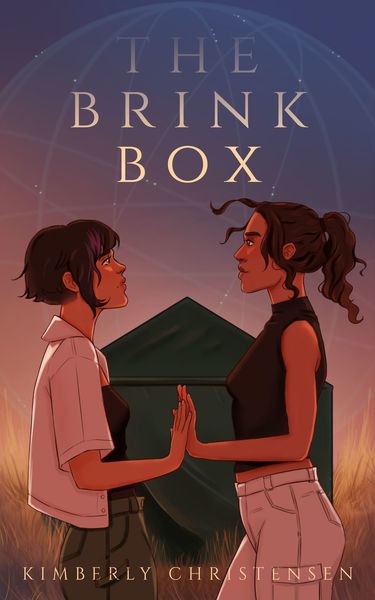
One reader describes the book:
A captivating tale about the power of sisterhood, the magic of technology, and how each person can help save the world.
From holographic safaris to the open savannas of Africa, this imaginative time traveling tale of two teen sisters and their magic Brink Box is a delightful and endearing adventure in a dangerous new world. Dazzle and Antsy shine as role models, showing us how heart and determination truly can make a difference—one baby elephant at a time!
It was super cool to reconnect with Kimberly and chat about the novel.
Mary: Tell us something about your life that not many people know about.
Kimberly: I trained as a midwife and attended births for a few years. It was profound work, but the more aware I became of the climate crisis, the more I struggled to reconcile adding humans to a planet that was already in danger. This is something I still wrestle with. At this point in my understanding, I believe that we must change systems first before we demand austerity from individuals. We can find ways to balance our basic human desires for love and companionship with our responsibility to the future world, and I don’t believe we should sacrifice the things that make us human (like love and companionship) instead of demanding a radical shift away from unfettered capitalism. But, I also have no plans to return to midwifery.
Mary: What led you to the creative outlet of writing?
Kimberly: Hope. I want to think that stories can help us imagine different ways of being, can prompt us to consider points of view we haven’t; can help us figure out solutions. Plus, I love to read. I think there can never be enough stories!
Mary: Tell us about your new book and what inspired it, or was it accidental?
Kimberly: I’d been writing a lot of stories about orcas (I really love orcas, especially the Southern Resident Killer Whales that live in Puget Sound), but I knew I needed to branch out. I began to read articles about elephant societies. There are many similarities between how the pods of orcas and herds of elephants work together. I’d also been reading a lot of articles about Lazarus species, the species that you see newspaper headlines about “Extinct bee found in the wild after 100 year absence!,” or “Not dead yet—elusive bird thought to be extinct sighted for the first time in sixty years!” Somewhere in my subconscious, a story about elephants and Lazarus species percolated. Because I love science fiction, there had to be time travel too. I got really lucky with The Brink Box as it pretty much plotted itself once those underlying concepts had time to stew in my brain. It seemed almost logical that time travelers would be responsible for reintroducing extinct animals.
Mary: How does your book align with nature and place?
Kimberly: I grew up in California, and even though I’ve been living in the Pacific Northwest for almost half my life, part of me still longs for hot dry weather of a California summer. It was easy for me to put myself back in that place, and to imagine what it would be like another century and a half into climate change. I wanted my main character, Daz, to be strongly rooted in that place too. She never wants to leave it, which makes her an anomaly in her family since both her parents were time travelers who not only explored other terrains, but other eras. Daz loves her home, even as she struggles with the scarcity and loss endemic to a future California. The fact that she is so strongly rooted in that place makes her decisions that much more difficult, and courage harder for her to muster. Home and place are safe and necessary, and should not be given up easily.
The Brink Box also tackles the sticky issue of human intervention in nature. If we’ve caused problems by being careless, unthinking, or exploitive, what lengths should we go to in order to fix those problems? What if we cause more problems trying to solve the original problems? At what point do we step back and let nature reclaim and recover without our help? How do we know what is ethical when it comes to trying to “fix” a human-made problem in nature?
Mary: Does your book have a message, or do you consider it more a piece of art? Or both?
Kimberly: It definitely has a message, and I would argue that all writing is persuasive writing. Why else would an author labor over pages and pages of words, if not to convince the reader of something? In my case, I’m writing eco-fiction, and while I want it to be entertaining, I mostly want people to think about what our responsibility is as humans living in the world. It’s not too late to change the future; any actions we take now will change it! We don’t need a time machine to help make the planet a better place for future creatures of all species.
Mary: What other writers and books do you enjoy and why?
Kimberly: Ray Naylor is my current favorite novelist. He also writes science fiction with environmental themes, and I find his works to be incredibly thought-provoking. The Mountain in the Sea blew my mind with its imagining of octopus culture and communication and its exploration of the desire for understanding, even between species. The Tusks of Extinction (about wooly mammoths) made me decide to not give up on getting The Brink Box to publication. The Earth needs its megafauna, and we have to fight for their right to exist into the future! Sim Kern’s The Free People’s Village is another current favorite. They tackle activism and community, and their importance in fighting back against capitalist-centered governments. I read The World Without Us at least 15 years ago, but I have not stopped thinking about it. I think I needed to know that if humans disappear the Earth will in fact heal. I obviously hope we can do better than making ourselves extinct, but there was a kind of peace to knowing that even if we fail, life on this planet will continue. I also love Camille Dungy’s poems and prose. Her words root me to this world and help me understand why place, nature and family are so necessary to our individual and collective well-being.
Mary: What’s next for you?
Kimberly: I’m pretty full of rage a lot of the time these days, and while I’m trying to find ways to channel that energy into something productive, stories about revenge keep rising to the top of my consciousness. There’s an old adage “nature bats last” as well as a million myths warning us about human hubris. I think nature might have some revenge up its sleeve. Those yachts sure aren’t sinking themselves, and I still love orcas. Somewhere in there I’m pretty sure my next story is percolating.
Mary: Let me know when that happens!
Bio
Kimberly Christensen writes from the rainy Pacific Northwest, where she’s also likely to be cuddled up with her faithful writing companion, Coco the dog, and hot cup of tea. When she’s not busy inventing new worlds, Kimberly loves to garden, tend her honeybees, play boardgames with her husband and two kids, dance with her English Morris dancing troupe, or try something new. Kimberly immerses herself in nerd culture, particularly Star Wars and Doctor Who, though she adores most any story in which smart and ethical saves the day.