Back to the Indie Corner series
Intro
During the summer and autumn, we often visit Wolfville’s Farmers’ Market in the lush Annapolis Valley of Nova Scotia. During one of those trips this past year, I was amazed to meet the most interesting author, Anne Smith-Nochasak. We talked for a long while as I flipped through her stunning books, which, as I would learn the more we talked, were the first of two in the Taggak Journey series. I bought the books and began reading them on the way home. They take place in Nova Scotia and New Brunswick in the future, and I love reading more about the forest, lakes, and wilderness, and how they might change if we do not get a hold of climate devastation—which we are not. The stories enhanced that ride home as well as many evenings as I sat outside or, eventually, as the weather cooled, by the fire reading. Who doesn’t like strong women (a rebel daughter and grandmother) fighting for our healthy ecological and ethical future. I say our, because fiction eclipses reality. I couldn’t help but catch quite a few connections with Anne. We both love dragonflies, not just because they are awesome, but because of what they symbolize to us, uniquely. I wouldn’t know until after I began reading her novels, but some of our writing themes are similar. I’ve also written a duology about people in the future in an apocalyptic world. In my second and final book, I also wrote about a pre-teen girl and a corrupt organization who wanted her for nefarious reasons. Anne and I even both love kayaking, even though I am still a newbie at it. The farmer’s market meeting was just by chance, but I’m glad it happened. Sinking into the books during the evenings and being carried forward into a wild and dangerous world, sparked with the eloquent prose of nature and jarred by humankind’s devastation, is certainly a ride.
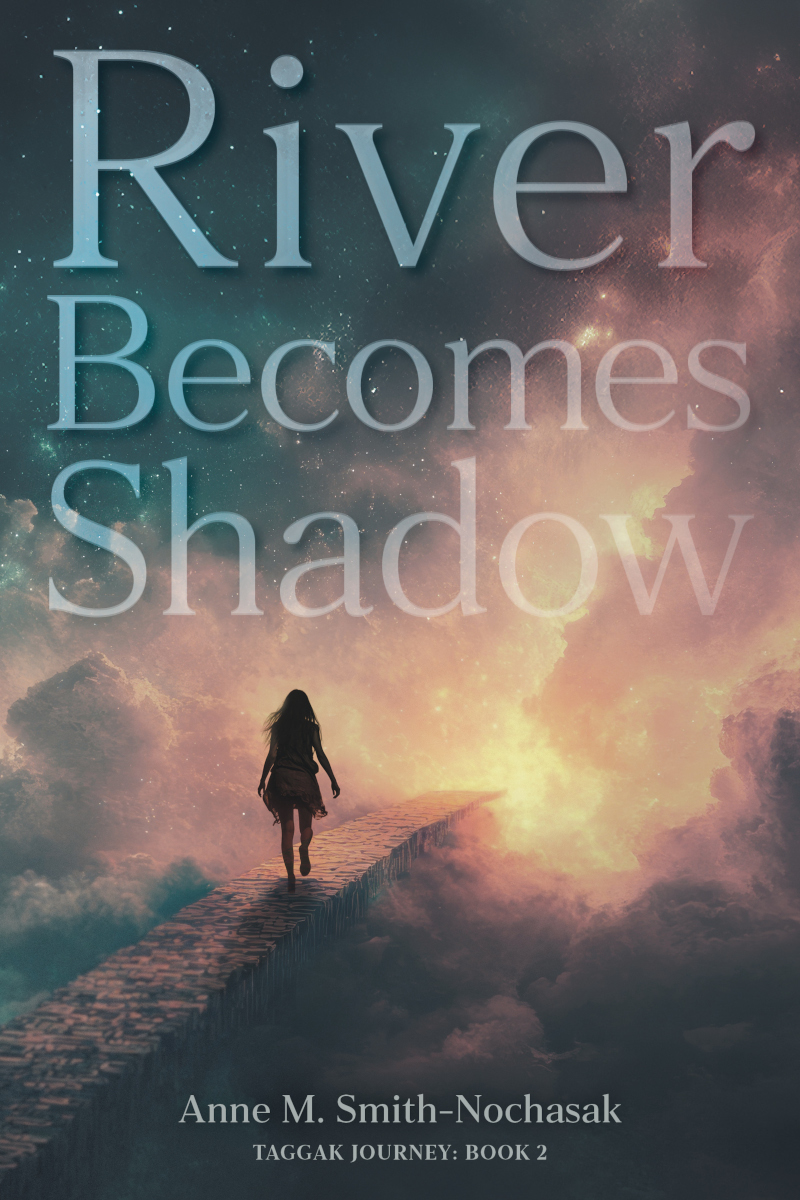
About the Books
Taggak Journey is a story of sacrifice, courage, and hope set in a dystopian near future. The author uses the word “taggak” because it describes the key aspects of main character River’s journey, which begins in River Faces North, told by River’s grandmother Flo. “Taggak”, according to Labradorimi Ulinnaisigutet: An Inuktitut-English Dictionary of Northern Labrador Dialect*, means “shadow, reflection in a mirror, north”.
In Book 1, River Faces North, it is said that one day, wherever River walks, the earth will turn green again. In the dying wasteland that is rural Nova Scotia and New Brunswick in the year 2036, this seems impossible. But where others see impossibilities, twelve-year-old River cultivates hope. She sees what a new world can be, even when the oppressive regime known as the Elect enslaves more and more people every day. Even if it means sacrificing herself along the way. In this second installment of the Taggak Journey trilogy, River has left Gran Flo and her swamp far behind. She’s joined by her cousin Tag, their guide to shadow running, a means to travel in secrecy requiring complete focus. But without proper food and sleep, how will they maintain the necessary concentration? And then there’s Dr. Andrea Parker, the keeper of stories—and resentment. Left to fester, her resentment might just ruin everything. As these unlikely heroes struggle forward, will they stay loyal to each other and to themselves, taking Flo’s voice and vision as their compass? Will River walk her path and fulfill Flo’s prophecy?
In Book 2, River Becomes Shadow, River has left Gran Flo and her swamp far behind. She’s joined by her cousin Tag, their guide to shadow running, a means to travel in secrecy requiring complete focus. But without proper food and sleep, how will they maintain the necessary concentration? And then there’s Dr. Andrea Parker, the keeper of stories—and resentment. Left to fester, her resentment might just ruin everything. As these unlikely heroes struggle forward, will they stay loyal to each other and to themselves, taking Flo’s voice and vision as their compass? Will River walk her path and fulfill Flo’s prophecy?
Keep an eye out for Book 3!
*August Andersen, William Kalleo, Beatrice Watts, eds. Nain, NL: Torngasok Cultural Centre, 2007
Chat with Anne
Mary: What led you to the creative outlet of writing?
Anne: As a child I would start stories, imitating the forms that I heard at bedtime, particularly ones about dogs. In school, I enjoyed writing. When I became a teacher, I connected with my students best in writing class. They loved to write, and so did I. I wrote little plays and stories for my students, and this encouraged them to read. But I was a teacher who conducted good writing classes.
Twenty years ago, I started spending my summers on a lake near Kejimkujik, paddling out to my cabin in early July and remaining until late August. In the afternoons, I began to shape a story, inspired by the lake and my childhood home on the farm. Each summer, I picked up my pen and stack of paper and sank into my story. It was a sacred connection for me; writing became my response to the world around me.
Mary: What writing communities are you a part of, and how do they help?
I take part in an online writing community through the Canadian Authors Association. I enjoy the non-judgmental analysis and fresh perspectives shared in our gatherings. I also collaborate with author A-M Mawhiney, having connected through her futuristic YA fantasy novel on the healing of the planet. Sharing similar visions for our future, we have been promoting each other’s work and engaging in regular correspondence for several years. We are a source of strength to each other. Through the online writers’ community, I have developed meaningful friendships with authors nearby and across the world
Tell us about your new book and what inspired it, or was it accidental?
Anne: My new book is River Becomes Shadow, Book Two in my dystopian trilogy Taggak Journey. Book One, River Faces North, took shape as the character of Flo Hardy introduced herself to me. Initially seen as more a comedic figure, a self-styled “rebel granny,” she soon revealed herself as a serious, albeit witty, voice for our times, whose environmental and social concerns reflected mine. I set her in a cataclysmic world ten years in the future and released her. She turned out to be, as she said, “a real rebel grandmother, not a fake one,” determined to save her granddaughter, who increasingly revealed herself as crucial to the earth. I needed to pursue this, and so a series began.
In River Becomes Shadow, Flo’s gifted granddaughter is now journeying through the apocalyptic wilderness with two companions. Their struggle is as much an endurance test through the blighted conditions of their world as it is a stance against social and political oppression. I believe that the strength they find in the wilderness is preparing them for the final ordeals they will face in Book Three.
Mary: How does your book align with nature and place?
Anne: In River Becomes Shadow, River and her supporters embrace on a fundamental level the interconnectedness of all creation. In River’s vision of the new creation, for example:
Every particle of raindrop, air, and earth are part of me.
And all of them flow in me, coursing in my blood, creating me.
. . .
Light has passed into me and through me,
A gift for creation and I am but the channel.
She is responsible to the earth, as are they all, for she is embedded in creation, and no action is separate. Thinking this way comes from my father’s profound respect for nature, a way of looking at the world consolidated by Indigenous teachings I have received. This is a dystopian novel set in a dying world, but ultimately, it is a plea to take a stand for the renewal of the earth.
Mary: Your book has a message. Do you also consider it a piece of art?
Anne: I would say it is a piece of art that has a message. Much of River’s story is constructed through my impressions of her time and the people needed to bring healing. My characters are heroes forged in a broken civilization, and I believe that people like them are our best hope.
Yet it is also a call to action: This is what love of the earth has summoned these people to do—we too must take a stand like this. It is not enough to say, “I agree.” I must act!
Mary: We met at a farmers’ market where you were selling your books, which was cool. Have you also been on book tours or community events to promote your book?
Anne: I find my greatest joy in attending farmers’ markets and craft fairs to promote my work. I showcase my books and sell copies at these events, but mainly I build awareness of my work and myself as an author. I enjoy the connections I have made, and had I not done this, I would probably not have connected with you, Mary, in Wolfville, and learned about the work you do with Dragonfly.
Mary: I loved that experience and hope to see you again there sometime. What’s your greatest experience in nature that profoundly moves your work?
Anne: My greatest experiences with nature have come from my Wasaya years, when I lived summers at my cabin. The lake was my road; my canoe was my car. My neighbours were the ducks nesting up the nearby creek, the beaver, the loons, the ospreys, and the terns. I shared the cabin—and canoe—with my three dogs. No electricity, plumbing, or internet. If I paddled out on the main lake, I could raise a cell signal in an emergency. It was a healing time, and when I write, my soul returns there to create its stories.
Mary: What’s next for you?
Anne: I am currently preparing Book Three of Taggak Journey for publication, entering the apocalyptic journey and witnessing the elemental forces that will begin the renewal. After that, I will be writing shorter works, perhaps collections of reflections that are more overtly nature driven.
Mary: Thanks for your time. I am looking forward to reading more.
Author bio
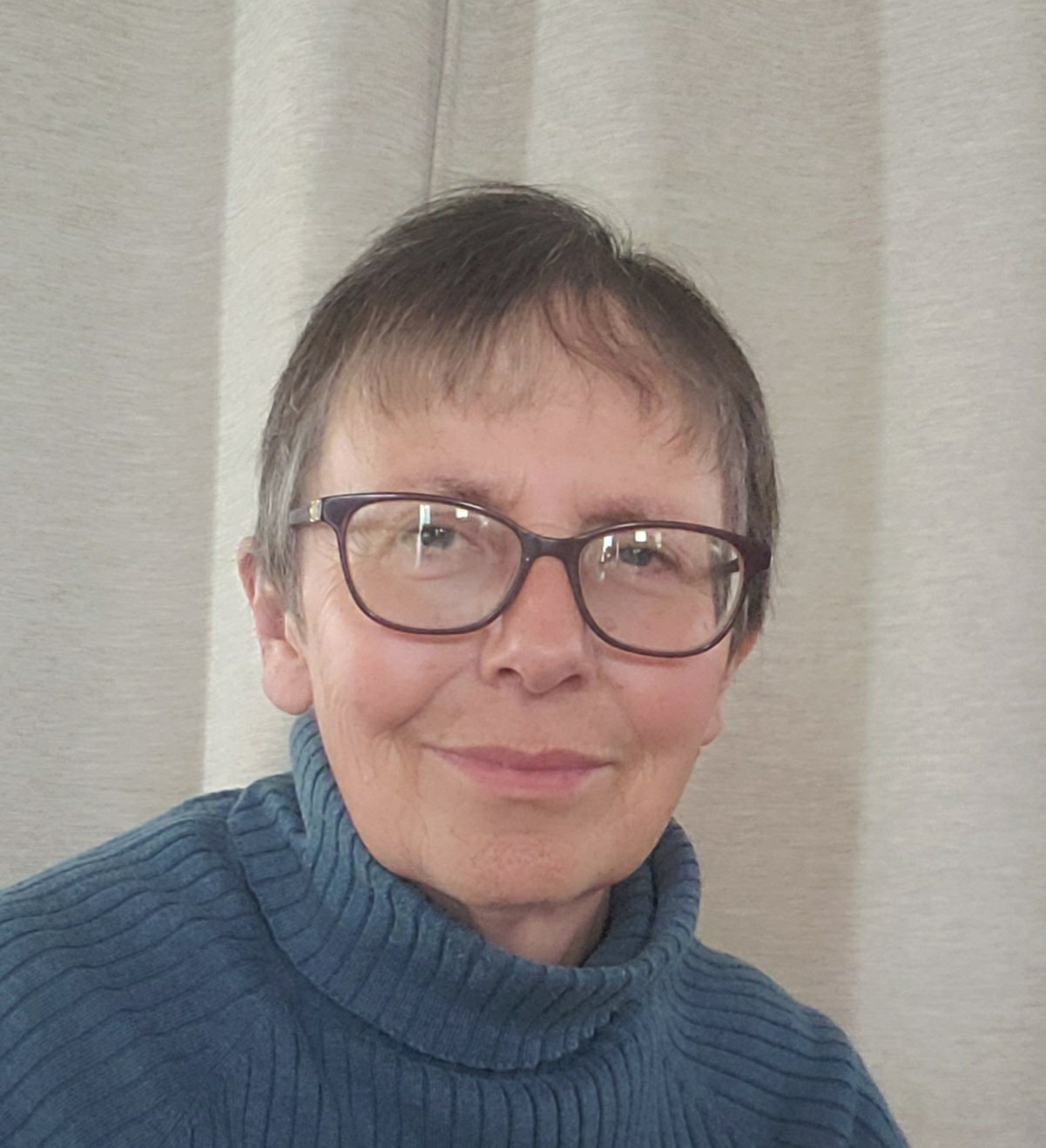
Anne M. Smith-Nochasak grew up in Nova Scotia, Canada, and taught for many years in northern Canada. Now retired, she lives in rural Nova Scotia in an area not unlike Flo’s swamp, with logging trails and rivers to explore. She teaches part-time, hikes, kayaks, gardens, tends her woodlot, and enjoys writing time. She has four published novels to date: A Canoer of Shorelines, The Ice Widow, River Faces North, and River Becomes Shadow. The conclusion to the River books, River Reflects Earth, should be out later in 2026.