Click here to return to the world eco-fiction series
About the Book
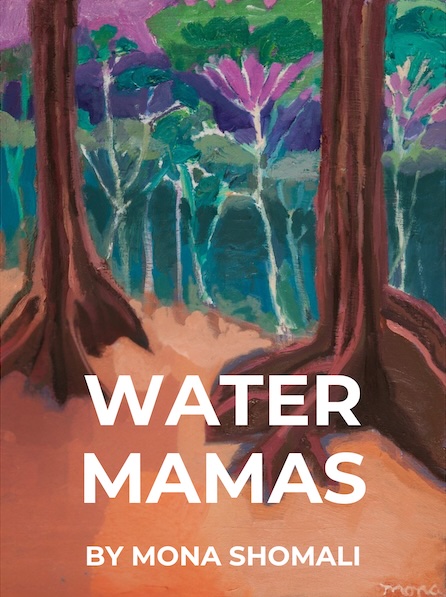
This month we travel to the Amazon with Mona Shomali, author of Water Mamas: A Novel of Climate, Spirituality, and Indigenous Human Rights. In the not-so-distant future, the Earth’s lungs are failing. A United Nations representative, Afa, finds herself deep in the parched heart of the Amazon, facing the ultimate ethical dilemma. Her mission: secure consent from Indigenous tribes to start a rain-seeding program. Rain cloud technology promises to reverse the ravages of climate change, to breathe life back into the global rainforests. But here, in the ancient heart of their lands, consent is not merely a formality; it’s enshrined in human rights law. Afa’s initial confidence crumbles in Guyana, where the very idea of man-made rain strikes at the core of Indigenous mythology and spirituality. It’s a clash of worlds—Western science versus ancestral wisdom—with the fate of the global climate hanging precariously in the balance.
Chat with the Author
Mary: Tell us something about your background in studying Indigenous human rights, including conflicts in the Amazon. What have you learned?
Mona: My most formative experience in the Amazon was when I was a case researcher on Sarayaku v. Ecuador in the Inter-American Court of Human Rights. The Sarayaku were suing Ecuador for illegally exploring for oil on their land without consent. According to international human rights law precedent, Indigenous peoples have the right to Free, Prior and Informed Consent (FPIC) on projects on their ancestral lands. One thing I learned is that tribes who live deep in the Amazon are highly sophisticated when it comes to their rights. They are informed of international instruments, and they had retained a lawyer from the Center for Economic and Social Rights in Quito, which is where I was working. Many people assume that Indigenous peoples living deep in the forest are cut off and living the life of the noble primitive, but that is an assumption that I try to fight with my book. It is possible to live in the forest in homes made of raw earthy materials, to fish in the Amazon rivers, and still have internet and cell phones. It does not make them any less Indigenous to be connected and globalized; connection allows people to learn more about how the Indigenous human rights landscape works.
Mary: What inspired you to apply some of your experiences in fiction?
Mona: I actually first wrote a nonfiction book that laid out many of these social justice, ecological, and human rights themes that I taught as an adjunct faculty professor in graduate courses about the role of culture in natural resource management. However, I got a lot of feedback that it was too boring and didactic and pedantic, to quote some literary agents. It just wasn’t gaining any traction, and I decided to ditch the nonfiction format and put my ideas, knowledge, and teachings into a compelling story with character arcs and twists and turns. I felt that climate fiction was more appealing than a quasi text book and that I could get my ideas across in a different way.
Mary: Your novel Water Mamas touches upon these issues. Can you let readers know more about the book?
Mona: My book is a fictional account of the conflict between Indigenous spirituality versus western science when it comes to fighting climate change. It takes place in the near future and is based on the present. Currently, the Amazon is approaching a tipping point. Scientists warn that once deforestation passes 20-25%, the rainforest may no longer generate its own rainfall, triggering irreversible collapse. But when the world rushes to save it, who gets to decide how? In my book, I explore what happens when Indigenous sovereignty is treated as an obstacle rather than a requirement.
The story is about a fictional UN-backed rain-seeding mission in the Amazon that collides with Indigenous belief systems and consent. The reluctance of the Indigenous peoples to give consent is due to the fact that they fear that the chemicals used in cloud-seeding and geoengineering will hurt the spirits that live in the forest. While fictional, the policy debates are real and are unfolding now. More than 50 countries already use weather-modification technologies, yet public debate often ignores the people most affected by these interventions. Many countries have had citizens protest cloud-seeding because of the use of chemicals, such as silver iodide, which ends up in the water. Citizens from Australia, for instance, have fought against cloud-seeding for years. In my book, I ask the question, “What happens when Western governments deploy geoengineering solutions without Indigenous consent?” Despite the fact that this is fiction, I focus on the ethical and legal consequences of climate solutions that prioritize technology over people.
Mary: The main character Afa is a UN representative who wants to introduce cloud-seeding to the Amazon, but this idea goes against Indigenous rights, which presents a personal learning experience for her. Can you describe the human rights explored in your novel?
As I mentioned above, the human rights legal precedent that guarantees Indigenous peoples consent over projects affecting their land is FPIC. The first case that established this precedent was the Case of the Mayagna (Sumo) Awas Tingni Community v. Nicaragua, decided by the Inter-American Court of Human Rights on August 31, 2001. The Court held that the State of Nicaragua violated the property rights of the Awas Tingni Community by granting to a foreign company a concession to log within the Community’s traditional lands and by failing to otherwise provide adequate recognition and protection of the Community’s customary tenure. This was the first case I researched as a case researcher; it established a precedent for Free, Prior, and Informed Consent promoting Indigenous rights globally.
Mary: Speaking of consent, we can see from the modern world and colonial conquests in history that it’s often overlooked. How do you feel about this?
Mona: I think consent is a huge part of what makes for a humane and civilized society. Whether it be between men and women or Indigenous peoples and their governments. In our current geopolitical situation, consent is on the table as we are entering a new wave of colonization by nationalist and populist super powers who seek to expand their statehood without consent.
Mary: I completely agree. On a lighter subject, an unforeseen romance complicates the issue. Without spoiling too much, who does Afa meet and what does she learn?
Mona: She meets a biologist who is studying the Macushi tribe in Guyana. He is trying to document their world view. He is less concerned with proving whether their beliefs are true or scientifically sound than he is trying to capture how they see their ecosystems through a cultural lens. Afa learns about the water mama spirits from the biologist. She learns that the Macushi believe that if the water spirits become agitated (as they perceive chemicals will agitate them), the water mamas will bring sickness and even death to the Macushi. She learns that the Macushi believe their culture will die if water mamas are not cared for and respected.
Mary: Anything else you want to say about the journey of writing this novel?
Mona: My goal in writing this book was to inform readers about that, by exploring morality through the struggle that Afa goes through, there’s a choice to make. Does she side with global scientists that are fighting global climate change, or does she side with the Indigenous human rights of the people whom she gets to know? What happens when we have to make a moral decision where we are absolutely torn? What does that mean for our character and person-hood? What does it mean for our moral compass to make such decisions? Obviously, I also want people to read this book so that I could share my experiences working with the Macushi and the Sarayaku in their struggle to actualize their human rights.
Mary: What now? Are you working on any other projects?
Mona: Firstly, I am the director of a youth environmental leadership program that takes place across the U.S., Mexico, and Canada. I love this job, I am suspended in a sense of what is possible because I am working with youth who are not yet jaded by experiences that shuts down their dreams. We support these youth, age 16-23, teaching them to manifest their activism through scaffolding, capacity, and skill building.
My second job is to promote this book. As a part of promotion, I have been giving nonfiction lectures in bars in the Bay area on subjects adjacent to the themes in the book. My last lecture was titled “Ethnoecology: How Myths Shape How We See Nature”. My upcoming lecture in February is “Oil Conflicts in the Global South: Case Studies of Iran, Ecuador and Nigeria”. In addition to these lectures, I am appearing on multiple podcasts. My next podcast will be with “Creatives Processing.” Look for it wherever you listen to your podcasts. I also publish essays and articles related to the themes of the role of culture in natural resource management. My last essay on Social Darwinism was in The Revelator. I have an essay coming up soon on how science is not neutral or void of cultural influence. It comes out soon in the Earth Island Journal. Check out my newsletter, where I publish essays on culture and environmentalism. And please check out Water Mamas wherever you buy your books. You can find it is at Barnes and Noble, Strand in New York City, and at your local bookstore.
Mary: Thanks so much for taking the time to talk about your book and about Indigenous rights and consent in the Amazon.
Author Bio
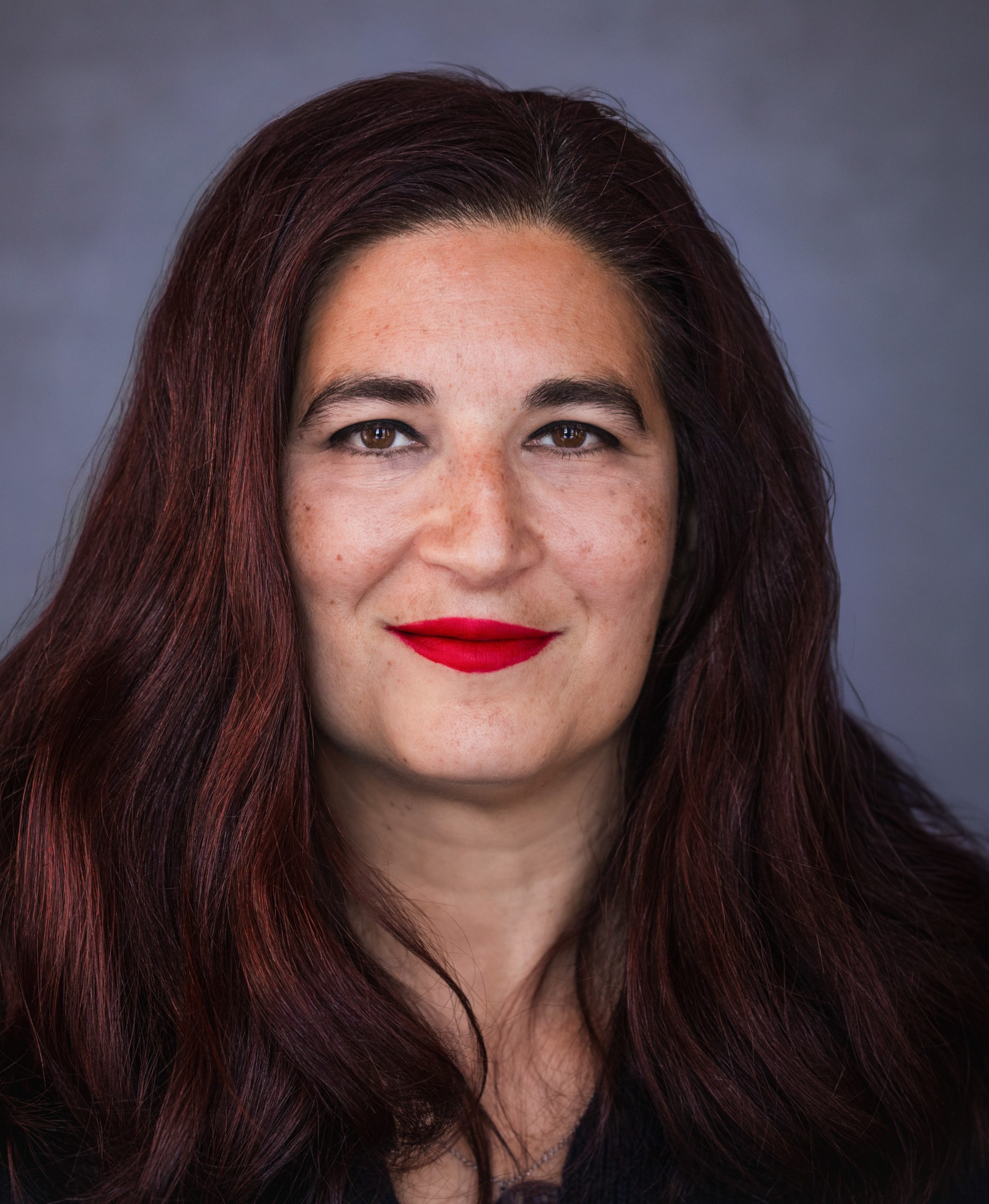
Mona Shomali is an Iranian American author and visual artist driven by a singular purpose: to explore how we navigate competing morals and worldviews. Her unique background, steeped in Indigenous Human Rights and Environmental Science, informs her brush and her prose. Mona’s journey into the heart of the Amazon started with her pivotal research work on the Sarayacu v. Ecuador case in the Inter-American Court of Human Rights. She worked on behalf of the Sarayacu tribe, who was suing the government of Ecuador for illegally allowing drilling on their ancestral land without consent. Having lived and worked with tribes in Guyana and Brazil, Mona has dedicated her career to teaching and sharing the crucial juxtapositions and cultural challenges inherent in Western environmentalism.
As an adjunct faculty member at The New School, Pace, and NYU, her courses focused on Indigenous human rights, resource conflicts in the Amazon, International environmental governance, and environmental justice. She also taught ecology at the New York Botanical Garden.
Mona’s paintings – like those in her “Invisible Stains” collection, which includes the cover art for Water Mamas, embody her commitment to these vital global conversations. Mona is now based in Oakland, CA.